




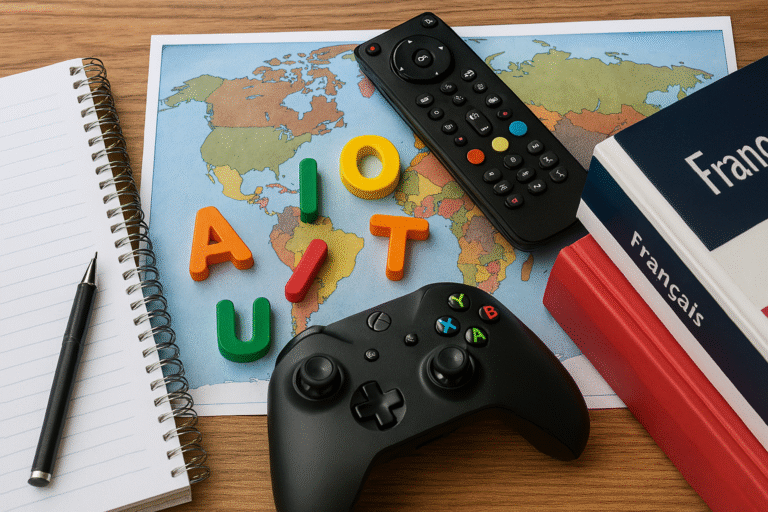
An Effective Strategy for Motivated Learning and Results
Gamification in Language Teaching It is a strategy increasingly used by students, teachers, and translators to make language learning more engaging, motivating, and effective. Learning a new language requires discipline and consistency. However, gamification transforms this journey into a fun, interactive, and rewarding experience.
In this article, you'll find out how the gamification in language teaching It can be applied in different contexts; why it works; what the benefits are for students and professionals; and tips for implementing it successfully.
What is gamification in language teaching?
A gamification in language teaching It involves applying typical game mechanics—such as points, levels, challenges, and rewards—to enhance language learning. In other words, instead of mechanically memorizing vocabulary lists, students unlock levels, earn digital badges, compete with classmates, and visually track their progress.
This approach is already used in apps such as Duolingo, Babbel e Memrise, as well as in brick-and-mortar schools and corporate platforms.
Why does gamification work in language teaching?
The effectiveness of the gamification in language teaching This is due to the way the brain responds to rapid and progressive rewards. In addition, every small victory releases dopamine, keeping motivation high even when facing challenging content.
In addition, gamification normalizes mistakes as part of the process, reducing anxiety and the fear of making mistakes. Therefore, it helps students persevere and improve without excessive pressure
Benefits of Gamification in Language Teaching
The use of gamification offers clear benefits for different audiences. Among these, we can highlight:
- Improves vocabulary retention
- Encourages daily practice with clear goals
- It makes learning more fun and less stressful
- It allows you to track progress in real time
- Encourages social interaction and collaboration within groups
In fact, a study by TalentLMS (2023) showed that 89% of students feel more motivated and productive when gamified strategies are used.
Practical Applications of Gamification in Language Teaching
In classrooms
Teachers create friendly competitions with leaderboards, prizes, and live quizzes to encourage participation. This helps students feel more engaged and collaborative.
On online platforms
Apps offer daily challenges, streaks, and digital medals to keep users engaged. In other words, progress becomes more tangible.
Among Translators and Interpreters
Platforms like ProZ.com gamify professional reputation through points, levels, and badges, encouraging continuous improvement. As a result, translators stay up to date and competitive.
For self-taught learners
Individual students can use apps or create their own personal challenges to stay on track. As a result, even without formal guidance, learning continues.
Real-world case studies
- A school in Lisbon reduced the dropout rate for language courses from 28% to 9% after implementing points, streaks, and group games.
- A startup in Brazil increased engagement among freelance translators by 73% by creating a gamified program that offered certifications and discounts to top performers.
These cases show how gamification directly contributes to the motivation of students and professionals.
Gamification in Language Teaching in Spiritual Contexts
Bilingual Bible study groups are already using gamification in language instruction to memorize verses and learn new languages at the same time. In addition, online discipleship programs use digital badges to track spiritual and linguistic progress. However, in these cases, the goal is to strengthen commitment to the faith, not just to accumulate points.
Tips for Applying Gamification in Language Teaching
- Set clear goals and break them down into small steps.
- Use apps with visual metrics to track your progress.
- Set rewards for milestones.
- Join groups or forums to compete in a friendly way.
- Vary the challenges to avoid monotony.
In this way, gamification becomes sustainable and effective.
Precautions When Using Gamification in Language Teaching
Despite its many benefits, gamification should complement solid content. Therefore, certain precautions are essential:
- Avoid prioritizing points and medals over true understanding.
- Make sure the challenges are pedagogically relevant.
- Remember that gamification is a means to engage—not the ultimate goal.
The Vision of Jana Büchi and JL Nissi
For Jana Büchi, learning needs to be light, deep, and constant. Thus, in her courses and mentoring sessions, she applies techniques of gamification in language teaching to practice legal vocabulary, oral presentations, and technical proficiency.
JL Nissi also plans to launch an exclusive program for Christian translators, combining gamification, technical training, and spiritual principles. In this way, progress is accompanied by purpose and meaning.
Useful links for further reading:
- Duolingo – A gamified platform for learning languages.
- Memrise – Language courses with game-based elements.
- ProZ.com – A network for translators with a gamified system.
And check out the blog as well: