




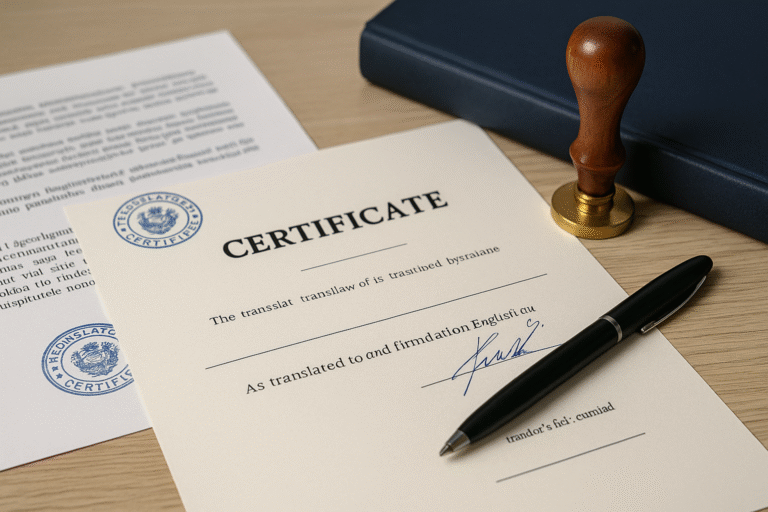
Ensure Your Documents Are Accepted Abroad
The globalization of professional and academic opportunities means that more and more people are seeking international validation of their documents. For this reason, diplomas, transcripts, proficiency certificates, internship statements, and many other documents must be translated accurately in order to be valid outside their country of origin. However, a simple translation is not enough. Specific precautions must be taken, and it is often necessary to rely on a certified translator who is well-versed in the standards required by international institutions.
Translation for International Certifications It goes beyond a technical service. In other words, it is a crucial step in ensuring that your documents are accepted without any issues by embassies, universities, or foreign companies. For this reason, here you'll learn how the process works, what types of translations are required, and how to ensure that your documents aren't rejected.
What Are International Certifications, and Why Do They Require Specialized Translation?
International certifications are documents issued by globally recognized institutions and valid beyond the borders of the issuing country. They can be academic, technical, medical, legal, or professional. To be accepted abroad, you must submit the original document along with a translation that meets local criteria. Thus, a specialized translation ensures fidelity to the content, terminological accuracy, and compliance with legal and academic standards. If you do not meet these requirements, your application may be rejected.
Types of documents that typically require translation
College degrees and course completion certificates
School or academic transcripts
Language proficiency certificates (TOEFL, IELTS, DELE, DALF, HSK, etc.)
Enrollment, internship, or volunteer work statements
Letters of recommendation and letters of motivation
Income tax returns and bank statements
Civil certificates (birth, marriage, death)
Immigration documents, visas, and naturalization
Each type of document requires a specific approach, with technical vocabulary and attention to detail. In addition, legal validation is often necessary. Therefore, always choose a qualified professional.
Sworn or certified translation: Which is required?
The difference between a sworn translation and a certified translation often raises questions. First, a sworn translation is mandatory in countries such as Brazil, where only public translators appointed by the commercial registries are authorized to perform it. This type of translation is officially recognized and constitutes a legal document.
On the other hand, a certified translation (or certified translation) is common in countries such as the United States, Canada, and the United Kingdom. It does not require a certified translator, but rather a professional who signs a formal statement guaranteeing the accuracy and integrity of the work.
Therefore, check in advance what the requirements are in the destination country before beginning the process.
How to Ensure Your Document Is Accepted
To avoid delays or extra costs, follow these practical recommendations.
Check the requirements of the destination institution by visiting the official websites of universities, embassies, or companies to learn about the guidelines
Choose a translator who specializes in official translations and is fluent in the target language
Have the translation signed and certified, as the translator must formally declare responsibility for the content
Keep the layout similar to the original to make it easier for the authorities to review it
Use letterhead and stamps when necessary, in accordance with the institution's rules
These steps significantly increase your chances of being accepted.
Common Mistakes That Lead to Rejection
Translating documents for international certification requires attention to detail. Therefore, avoid the most common mistakes.
Leaving the translation to someone who isn't qualified
Do not include the translator's signature or stamp
Using poorly translated or ambiguous terms
Omitting important information
Display disorganized formatting
These precautions help you maintain your credibility with the institutions you are applying to.
Translation for Technical and Professional Certifications
In addition to the academic field, there is a growing demand for translations of professional certifications such as PMP, CFA, CPA, AWS Certified Solutions Architect, and Microsoft, Cisco, and Google certifications. Therefore, having a translator who is familiar with the technical terminology is essential to ensure the document is analyzed correctly.
Multilingual Translations for International Mobility
With global mobility on the rise, it's common for documents to need to be translated into more than one language. For example, a Brazilian student who plans to work in Portugal and pursue a master's degree in Germany may need their diploma in English, European Portuguese, and German. In this case, it's best to hire a translator with experience in multilingual projects who knows how to meet the standards of each country.
How JL Nissi is involved in this process
JL Nissi, led by Jana Büchi, specializes in certified translations for international certifications. The team is well-versed in the academic and legal systems of Europe, North America, and Asia. As a result, it guarantees faithful, accurate translations that are accepted by the relevant authorities.
Services include technical document translation, linguistic adaptation to meet the requirements of the destination country, a formal translator's statement, support for Hague Apostille certification, and personalized assistance for more complex cases. In addition, Jana guides clients throughout the entire process, providing reassurance and clarity.
Conclusion
Translating documents for international certification goes beyond simply converting words. In practice, it is a technical, legal, and cultural service that requires responsibility and a commitment to excellence. By hiring a qualified professional, you ensure peace of mind and increase the chances that your documents will be accepted without any unexpected issues.