




Differences, Applications, and How to Choose
In today's globalized world, where meetings, conferences, and international events are now part of everyday life, the presence of a specialized interpreter has become indispensable. However, when seeking this service, many people encounter two terms that raise questions: simultaneous interpretation and consecutive interpretation. Although both are forms of oral interpretation—and not written translation—they have significant technical, contextual, and operational differences.
In this article, you will gain a clear understanding of what sets each option apart, when to use them, the advantages and limitations of each, and how to choose the ideal service for your event, course, or international meeting. This will help you make the best decision.
What is simultaneous translation?
Simultaneous translation, also known as simultaneous interpreting, takes place in real time. In other words, as the speaker talks, the interpreter translates for the audience with a slight delay of just a few seconds. Therefore, this type of translation requires a high level of concentration, fluency, and technical mastery of the subject matter.
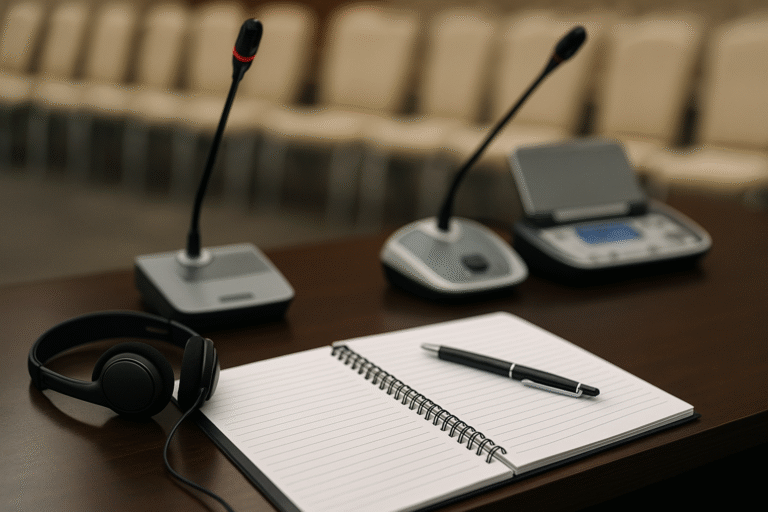
In addition, at larger events, simultaneous interpretation requires specialized equipment. The interpreter works in a soundproof booth, using headphones and a microphone, while the audience receives the translation through receivers with headphones. This allows communication to flow naturally, with almost no interruptions.
Examples of Simultaneous Interpretation Applications
International conferences
Multilingual seminars
Conferences with an international audience
Classes and training sessions for participants from different countries
Live Broadcasts for Multilingual Audiences
International interviews or press conferences
Advantages of Simultaneous Interpretation
Agile and Continuous Communication
An immersive experience for the audience
Ideal for large events and online broadcasts
It allows you to support multiple languages at the same time
Disadvantages of Simultaneous Interpretation
Higher cost, due to the need for two teams and equipment
Essential logistics planning (booths, headsets, sound technician)
Greater mental fatigue for the interpreter, which requires taking turns
What is consecutive interpreting?
Consecutive interpreting, on the other hand, is different. In this type of interpreting, the speaker talks for a period of time—usually between two and five minutes—and then pauses so that the interpreter can translate the message. The interpreter typically takes quick notes to ensure accuracy and coherence in the interpretation.
For this reason, consecutive interpreting is more intimate and is widely used in business meetings, interviews, technical visits, smaller presentations, or bilateral meetings. In addition, it is a good choice for informal situations or when on a tight budget.
Examples of consecutive interpreting applications
Business Meetings and Networking
Negotiations between companies
Classes or mentoring sessions with a single foreign instructor
Technical presentations on products or solutions
Ceremonies, medical or legal consultations attended by foreigners
Advantages of consecutive interpreting
No special equipment required
More affordable
Ideal for small groups or one-on-one meetings
It provides opportunities for reflection and greater control over communication
Disadvantages of consecutive interpreting
Communication takes twice as long
The pace of the presentation may be disrupted
It requires patience on the part of the participants
It depends on the interpreter's memory and ability to synthesize information
How to Choose Between Simultaneous and Consecutive Interpretation
To make the best decision, consider the following factors.
Event size: For large audiences or when more than one language is involved, simultaneous interpretation is the best option.
Length of lines: Long presentations are better suited to simultaneous interpretation, while short dialogues are better suited to consecutive interpretation.
Equipment availability: If there is no infrastructure for booths and headphones, opt for the consecutive format.
Budget: Generally, consecutive interpretation is less expensive.
Purpose of the meeting: Strategic meetings and negotiations benefit from consecutive interpreting. Lectures and training sessions, on the other hand, flow better with simultaneous interpreting.
Profile of the Ideal Interpreter for Each Modality
Both types of interpreting require fluent interpreters with technical vocabulary and quick thinking. However, there are subtle differences.
For simultaneous interpreting, the interpreter must have intense concentration, active listening skills, emotional resilience, and experience with equipment and stage environments.
In this role, the professional needs an exceptional memory, the ability to take notes quickly, the ability to synthesize information, and strong interpersonal communication skills.
The Importance of Preparation and Advance Briefing
Many clients think that simply speaking the languages is enough to interpret well. However, advance preparation makes all the difference in the quality of the service.
Therefore, please follow these recommendations:
Send supporting materials in advance
Please provide the proper names, brand names, and technical terms that will be used
Explain the purpose of the event and the audience profile
Allow the interpreter to meet with the speakers in advance
As a result, the delivery will be much more accurate, and the audience will have a positive experience.
How JL Nissi Provides Simultaneous and Consecutive Translation Services
JL Nissi, led by Jana Büchi, offers specialized simultaneous and consecutive interpretation services for national and international events. In addition to Portuguese, English, French, and Spanish, the team provides services in Cantonese and Mandarin, always prioritizing technical excellence, discretion, and cultural respect.
In addition, JL Nissi guarantees:
A team ready for an efficient relay
Technical support for equipment installation and operation
Services at trade shows, conferences, private meetings, and online broadcasts
Culturally sensitive interpretation, tailored to the client and the context
It also offers complementary services, such as slide translation, post-event review, and bilingual executive summaries highlighting the key points discussed.
In summary, the choice between simultaneous and consecutive interpretation depends on the type of event, the audience, the budget, and the objective. Each method has its ideal applications and specific benefits. The most important thing is to ensure that the service is provided by qualified professionals who are technically skilled and culturally sensitive.
Whether it's for a global conference or a strategic meeting, investing in professional interpretation reinforces your message, bridges cultural divides, and delivers tangible results.