




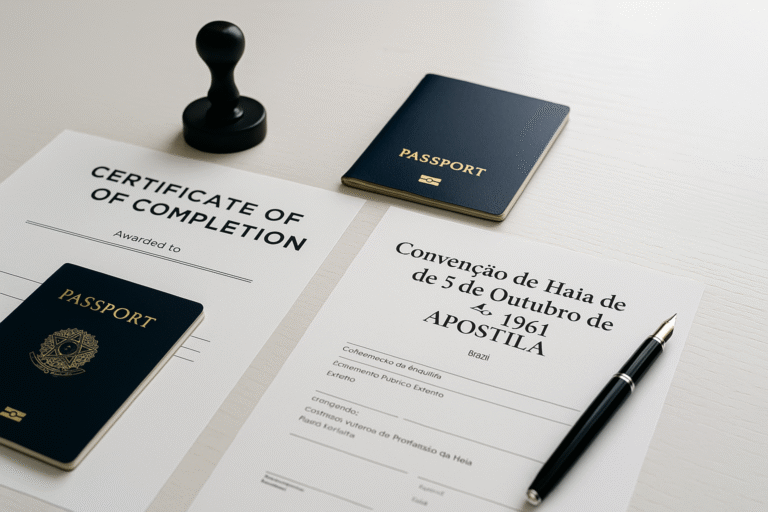
Complete Guide by Country and Type of Use
When someone decides to live, study, work, or start a business in another country, one of the most important—and often overlooked—steps is having Brazilian documents validated abroad. Certificates, diplomas, criminal records, powers of attorney, and contracts must undergo a process that varies from country to country and may include certified translation, apostille, consular legalization, and international recognition.
That's why, in this comprehensive guide, we explain how this process works, which documents require validation, what the Hague Convention is, how to prepare for consular requirements, and what common mistakes to avoid. In addition, we provide practical examples by country to make your journey easier.
Why Get Brazilian Documents Authenticated Abroad
Foreign countries do not automatically recognize the authenticity of documents issued in Brazil. This is because each country has its own legal system, its own laws, and specific criteria for accepting documents as valid. Thus, validation is the process that legally proves that a Brazilian document is authentic, genuine, and enforceable in that country.
Without this process, Brazilian documents may be considered invalid outside the country. Consequently, you may encounter obstacles in situations such as: enrolling in universities abroad, having diplomas recognized, international marriage, naturalization, buying and selling real estate, opening bank accounts, or participating in legal and administrative proceedings.
Main Types of Validation
To begin with, it’s helpful to understand the most common mechanisms:
- Certified translation: Required when the destination country does not have Portuguese as an official language. In addition, the translation must be done by a certified translator.
- Hague Apostille: It serves as international authentication of public documents for countries that are signatories to the Hague Convention.
- Consular legalization: used for countries that are not parties to the Hague Convention; this process is handled directly by the consulates.
- Notarization and Authentication at a Notary Public's Office: a common requirement for ensuring the authenticity of signatures on private documents.
What Is the Hague Apostille Convention?
The Hague Apostille Convention is an international treaty that simplifies the process of legalizing documents among signatory countries. Instead of having a document legalized by various agencies and at the consulate, it is sufficient to obtain an apostille, which is issued by authorized notary offices in Brazil.
Brazil has been a signatory since 2016. Therefore, countries such as the United States, Portugal, Spain, France, Germany, Italy, Japan, Australia, Canada, and Hong Kong accept Brazilian documents bearing an apostille.
What is an Apostille?
An apostille is a stamp or certificate issued by a competent authority (usually an authorized notary’s office) that authenticates the origin of a public document. Important: The apostille must be obtained in Brazil, in the state where the document was issued. Therefore, for translated documents, a certified translation must be done first, and only then are both the original and the translation apostilled.
Consular authentication: when is it required?
However, some countries are not parties to the Hague Convention. In such cases, consular legalization is required—that is, the document must be taken to the embassy or consulate of the country in question. For example, Canada (in some cases), Cuba, Bolivia, Iran, and Angola still require this procedure.
Common Steps for Validating Brazilian Documents
To ensure the process goes smoothly, follow these steps:
- Issue the original document (certificate, diploma, transcript, etc.)
- Have the signature notarized, if necessary
- Translate using a certified translator (into the required language)
- Certify the original documents and their translations
- Forward to the destination country
Difference Between a Simple Translation and a Certified Translation
While a simple translation has no legal standing and is intended solely for informational purposes, a certified translation is performed by a certified translator and is legally valid, meaning it can be used in legal, academic, immigration, and administrative proceedings.
Practical examples by country
In addition to the general rules, each country has its own nuances. Here are a few examples:
- Portugal: It accepts Apostille certification and certified translations, but may require European Portuguese for the recognition of degrees.
- United States: Apostille certification is accepted, but certain organizations require a translator with ATA certification.
- Germany: It requires an Apostille and a German translation, which is often done by a certified translator in that country.
- France: It requires an apostille, but you may request additional certification of the translator's signature.
- Italy: Requires a certified translation and specific procedures for citizenship.
- Australia and New Zealand: They accept documents with an Apostille, but for immigration purposes, a NAATI-registered translator may be required.
- China (including Hong Kong): Hong Kong accepts the Apostille, but mainland China still requires consular legalization.
Tips for Avoiding Mistakes
Finally, please note the following points:
- Never send the original without confirming the country's requirements
- Do not have the document apostilled before having it officially translated
- Please confirm whether the translation can be done in Brazil or needs to be done in the destination country
- Avoid low-quality scans
- Seek guidance from professionals with international experience
How JL Nissi Simplifies the Process
JL Nissi offers comprehensive assistance with international document authentication. Therefore, our services include:
- Certified translation in various languages
- Apostille certification at authorized notary offices
- Consulting Services for Consular Legalization
- Physical and digital delivery of documents with tracking
- Specialized support by destination country
In addition, we guarantee personalized service for each case, with a focus on security and compliance.
Certifying Brazilian documents for use abroad is a crucial step toward opening doors outside the country. With expert guidance and proper preparation, this process becomes quick, secure, and efficient.
By choosing an experienced partner like JL Nissi, you can avoid mistakes and ensure that your documents are accepted without any setbacks. That way, your international dream can come true with peace of mind and confidence.